

Ask a facilities manager what their biggest operational headache was five years ago, and they would probably say HVAC systems or access control. Ask them today, and a growing number will tell you it is batteries, specifically lithium-ion batteries.
The electrification of tools and equipment across UK industry has accelerated dramatically. Cordless drills, electric pallet trucks, robotic cleaning systems, handheld scanners: the shift away from mains-powered and combustion-engine equipment is well underway, and it is not reversing. Tool electrification is up 65% across the sector, and the charging infrastructure required to support it has not kept pace.
Correct storage of these batteries is rapidly moving from an operational inconvenience to a safety and compliance issue with real financial consequences, and one that facilities teams are increasingly being asked to solve, often with limited guidance on what good actually looks like.
What Is Driving the Electrification Shift, and Why It Creates Infrastructure Pressure
The drivers are well understood: ESG commitments, cost reduction, improved tool performance, and tightening emissions regulations in enclosed spaces. What is discussed far less is the infrastructure pressure this shift places on site management.
When a site moves from diesel-powered equipment to lithium-ion alternatives, the batteries do not disappear at the end of a shift. They need to go somewhere to charge. In many warehouses, manufacturing facilities, and FM environments, charging quickly becomes improvised: spare sockets, extension leads, batteries left on the floor or stacked on workbenches. That improvised approach works, until it does not. The UK Health and Safety Executive has been increasingly clear: ad-hoc lithium-ion charging arrangements represent a significant and underappreciated risk.
The Compliance Landscape: What Indoor Charging Actually Requires
UK guidance and regulatory expectations around indoor lithium-ion charging have evolved rapidly, and they are far more specific than many facilities teams realise. Simply designating a “charging area” is not enough.
For indoor environments, charging infrastructure must be designed, tested and installed with effective risk containment. As a minimum, an indoor charging solution should provide:
RCD protection. A Residual Current Device detects electrical faults and cuts power before they escalate. This is a fundamental requirement for indoor charging.
Thermal runaway containment. Lithium-ion cells that overheat enter an irreversible failure state. The charging unit must be built to contain thermal runaway within the enclosure, preventing spread to the building, stored goods or personnel. This is the most critical structural requirement.
Ventilation management. During fault conditions, lithium-ion cells can release flammable and toxic vapours. Indoor charging units must control ventilation to prevent vapour build-up inside the unit or in the surrounding area. This requirement is often overlooked in improvised or consumer-grade setups.
Independent real-world testing. Standards provide a framework, but real fire scenario testing demonstrates how a unit performs under actual failure conditions. This is the most reliable benchmark for indoor deployment which are designed specifically for controlled, compliant indoor use.
Space, Safety, and Scalability: The Three Things Your Charging Setup Must Deliver
Most facilities do not have unlimited floor space, and a charging solution that addresses the safety problem while creating a spatial one has not really solved anything.
Indoor environments bring real constraints:
- Fixed aisle widths
- High-traffic loading zones
- Fire exits and emergency routes
- Throughput pressures in busy operational areas
Consider a busy warehouse or FM site. Aisle widths are dictated by racking layouts. Loading bays have throughput requirements. Emergency exit routes must remain clear. A charging station designed for a spacious outdoor compound will not work in these environments, and many currently available solutions were not designed with indoor space constraints in mind.
Scalability is equally critical. As electrification increases across a site, charging demand grows with it. The infrastructure decision made today needs to scale incrementally; without requiring disruptive redesigns, additional electrical work, or new compliance assessments every time capacity increases.
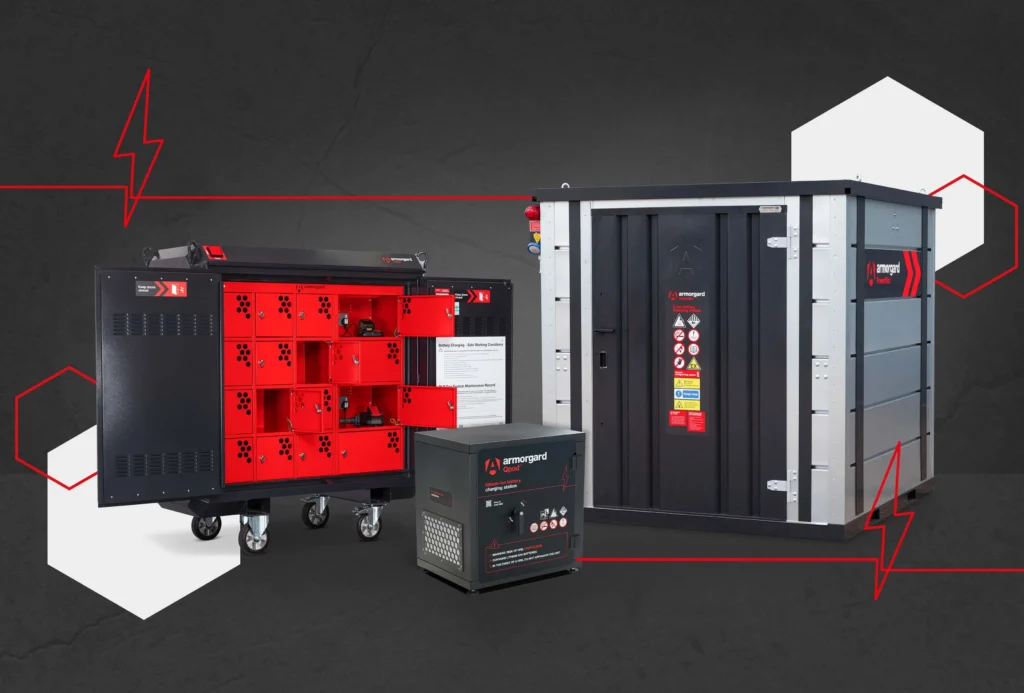
This is where modular, space-efficient systems such as the QPod, are set to play a key role.
A Buyer’s Checklist: What to Look for When Specifying an Indoor Charging Solution
Before committing to any indoor battery charging infrastructure, run through these questions:
- Is it specifically certified for indoor use in the UK, not just broadly compliant?
- Does it include built-in RCD protection as standard?
- Has it been tested against real-world thermal runaway scenarios, not just theoretical lab conditions?
- Is the footprint small enough to integrate into your existing floor plan without compromising workflow?
- Is installation genuinely plug-and-play, or does it require specialist work that adds time and cost?
- Who manufactures it, and do they have a credible track record in lithium-ion safety?
These are not tick-box questions for a procurement form. They are the difference between infrastructure that genuinely protects your site and people, and infrastructure that looks the part but leaves you exposed.
The electrification wave is not slowing down. The question is whether your charging infrastructure is ready to meet it, or whether you are one improvised cable run away from a very expensive lesson.