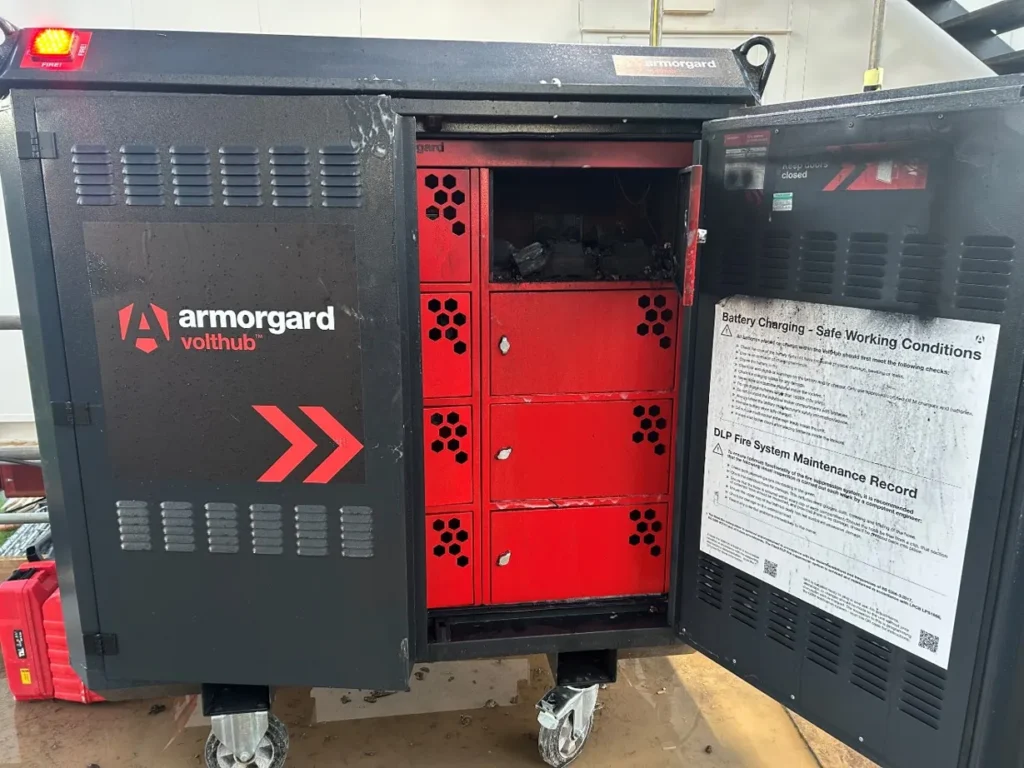



Let’s start with a number: £50,000.
That is the average cost of a lithium battery fire insurance claim in the UK. Not the worst case, the average. Some severe incidents have exceeded £400,000, and that figure covers only what ends up on the claims form.
It does not account for the true cost of a lithium-ion battery fire on site: days or weeks of lost productivity while investigations take place, the replacement of damaged tools, stock, and infrastructure, management time spent dealing with insurers and regulators, or the reputational impact with clients, insurers, and employees.
The argument for investing in proper indoor lithium-ion charging infrastructure is one of the clearest cost-benefit cases in facilities management. Yet across the UK, businesses are still operating charging arrangements that leave them fully exposed to the £50,000 average and everything that comes with it.
Breaking Down the True Cost of a Lithium-ion Incident
Insurance claims tell only part of the story. When a lithium-ion fire occurs on site, the direct costs are the most visible part of the picture, and rarely the most damaging.
Operational shutdown. Sites that have experienced a serious battery incident do not just pause operations for a morning. Depending on severity, shutdowns can last days or weeks while the site is made safe, investigated, and cleared. For a busy warehouse or production facility, the cost of that downtime far exceeds the direct damage.
Regulatory investigation. A serious incident on site will typically trigger an HSE investigation. If non-compliant charging infrastructure is identified as a contributing factor, the consequences can include improvement notices, prohibition notices, or prosecution, each of which carries its own significant cost and operational disruption.
Insurance implications. Insurers are scrutinising lithium-ion charging arrangements with increasing rigour at renewal. A claim linked to non-compliant infrastructure can result in premium increases, exclusions, or in some cases, difficulty obtaining cover at all.
Reputational impact. For businesses that supply to major retailers, logistics networks, or public sector clients, a serious safety incident can affect supplier status and commercial relationships in ways that are difficult to quantify and harder to reverse.
The Insurance Angle: Why Your Charging Infrastructure Affects Your Premium
This is the part of the conversation that often surprises operations and procurement leads. Your charging setup is an underwriting consideration as much as a safety one.
As claims for lithium-ion battery fire incidents continue to rise, insurers have started asking more specific questions about how businesses manage charging and storage:
- Is the charging equipment designed and tested for safe indoor use?
- Does it include RCD protection?
- Is it properly contained?
- Has it been independently tested against real-world fire and safety scenarios?
Businesses that can answer yes to these questions are increasingly well-placed at renewal. Those that cannot, or that struggle to evidence compliance, are finding that their exposure is reflected in their premiums. Compliant indoor charging infrastructure is, in effect, a risk-management tool with a direct, measurable financial return.
What Plug-and-Play Really Means for Site Productivity
There is a common assumption that upgrading safety infrastructure is disruptive: that it involves specialist installation, workflow interruption, and a lengthy settling-in period. With the new Armorgard Qpod, that assumption does not apply.
A genuinely plug-and-play solution means no specialist electrician required for setup, no complex integration with existing systems, and no re-engineering of your floor plan to accommodate a bulky unit. Your team can deploy it, understand it, and use it from day one, with operations continuing without interruption. For site teams, this matters considerably. Solutions that require extensive training, ongoing maintenance regimes, or frequent troubleshooting introduce hidden costs and attention that site teams do not have to spare.
Framing the ROI: One Prevented Incident vs. the Cost of a fit for purpose solution
The return on investment is straightforward.
You do not need to experience a fire to model what one would cost. Against the average UK claim of £50,000 (plus downtime, regulatory scrutiny, and insurance implications) the cost of a rigorously tested, compact, indoor-optimised charging solution is a fraction of what a single incident would set you back.
And the upside here is grounded in probability, with data showing 54% of businesses have already experienced a lithium-ion incident, and UK lithium-ion battery fires increased by ~93% between 2022 and 2024; the likelihood of exposure without proper infrastructure in place is meaningful.
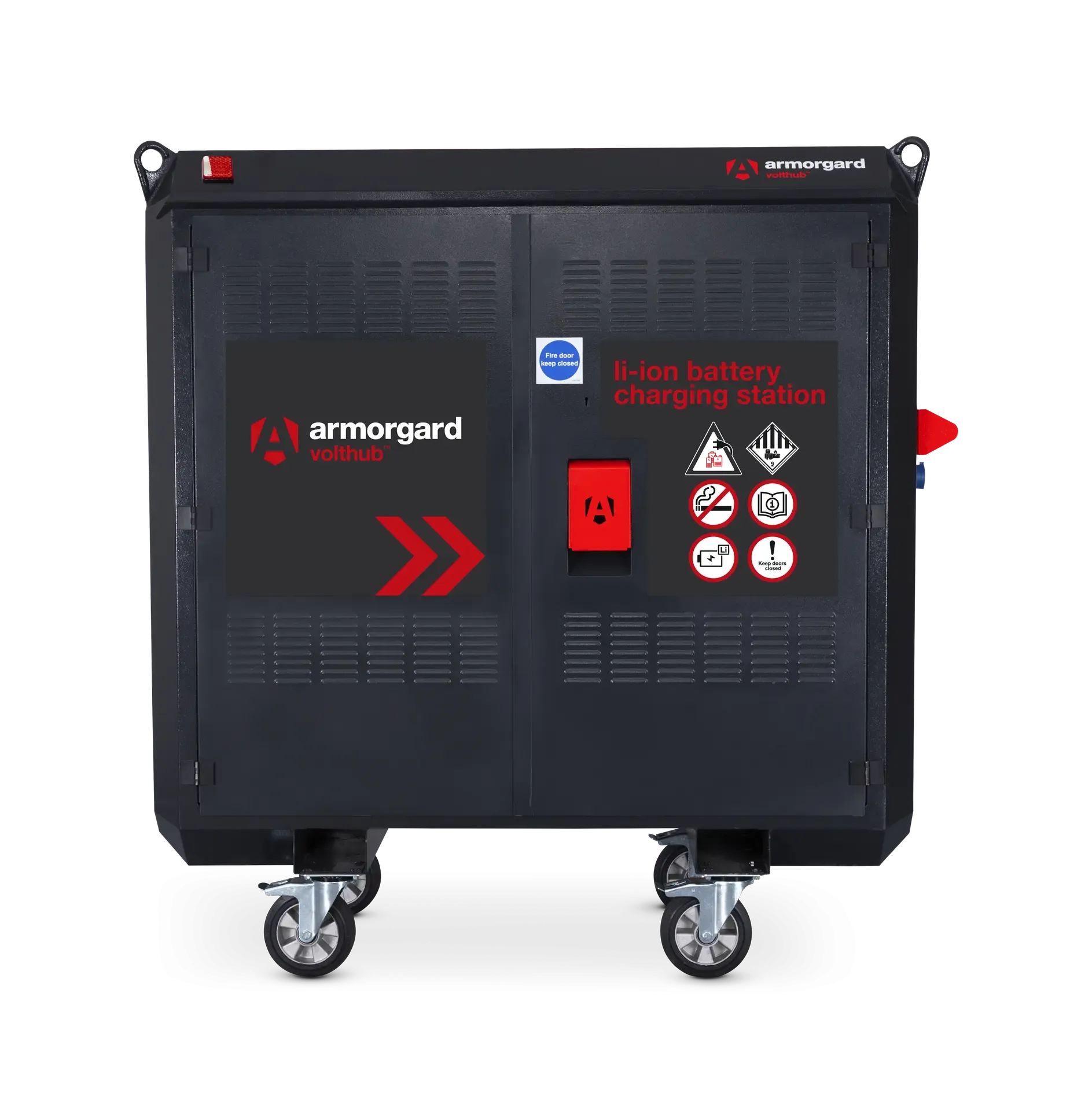
The Qpod is the commercially rational choice: robust construction, built-in RCD protection, independently tested for indoor use in real-world fire scenarios, and compact enough to work in the spaces you are actually operating in.
Sources
https://www.allianz.co.uk/news-and-insight/news/average-cost-of-battery-fire-claims-hits-50k.html